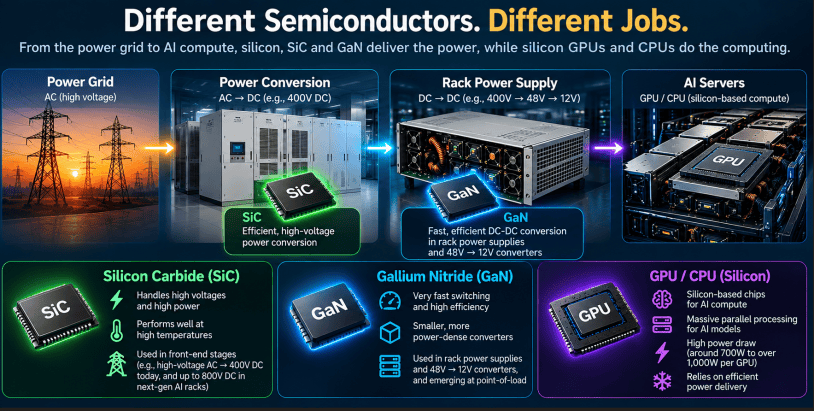
Everyone is racing to buy more GPUs. Very few are asking what happens to the electricity before it gets there.
Before a single token is generated, power travels through several conversion stages from the grid to the chip, and every stage loses some energy as heat. In one server that loss looks small. Across a data center running thousands of GPUs, it adds up to real money, real heat and real cooling load. That is why I believe AI’s next big semiconductor story may be about power, and a material called Gallium Nitride, or GaN.
First, an important clarification. GaN is not an alternative to the silicon inside your CPU or GPU. The GPU still does the computing. GaN comes into the picture in the power electronics around it, where power is converted from one voltage and current level to another. I think of it as the difference between the brain and the power system feeding the brain.
Why is GaN interesting?
It is a wide-bandgap semiconductor that handles higher electric fields than silicon and switches much faster. Power converters use transistors as extremely fast switches, and the faster they switch, the smaller you can make inductors, transformers and capacitors. The result is lower switching losses, higher power density and significantly smaller power supplies than equivalent silicon designs.
This is important as AI racks move toward hundreds of kilowatts and eventually megawatt-scale infrastructure. At that scale, even small gains in conversion efficiency mean meaningful savings in electricity, heat and cooling.
A common question we hear is; “Is GaN better than silicon?”
For power conversion, largely yes. It switches faster, wastes less energy and takes less space. But the full picture is a chain from grid to chip. Silicon Carbide (SiC) handles the high voltages where power enters the data center. GaN converts that power efficiently near the rack and board. Silicon GPUs and CPUs do the computing. I believe all three will coexist, each doing what it does best. GaN still has work ahead on heat, reliability and cost.
When we talk about the future of AI infrastructure, I think we need to look beyond the GPU. AI needs compute, compute needs power, and delivering that power efficiently is an engineering challenge of its own. GaN may not be the chip that runs the AI, but it could be one of the technologies that powers AI at scale.
I write about #artificialintelligence | #technology | #startups | #mentoring | #leadership | #financialindependence
PS: All views are personal

