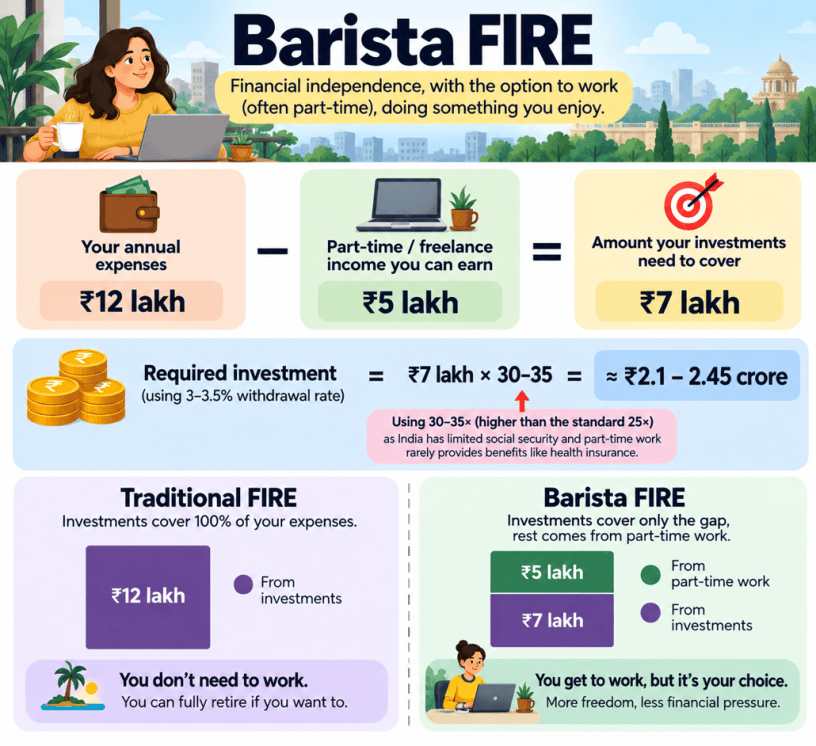
That question is the entire idea behind Barista FIRE. It is not about having enough money to never work again. It is about having enough invested assets that work becomes optional rather than necessary.
Imagine a product manager in Pune who steps back from a full-time role to consult three days a week for two clients, letting her investments cover the rest. Instead of building a portfolio that funds all your expenses through withdrawals, you ask what part-time or freelance income you can dependably earn, and your portfolio only needs to cover the gap.
Here is where I’d push back on how this is usually taught. Most FIRE content applies the 4% rule and its 25 times multiplier everywhere, but that rule was built around US market data and a different retirement ecosystem. In India, retirement income and healthcare depend much more on your own assets, and coverage through EPF, NPS and employer benefits is uneven.
For India, I would personally use a higher multiplier, closer to 30 to 35 times, particularly for early retirement. That is not an established number, it is my own planning assumption, corresponding to a withdrawal rate closer to 3 to 3.5 percent rather than 4.
Also, the bigger catch when it comes to part-time jobs is in the word “reliably”. A salaried 5 lakhs and 5 lakhs of consulting income are not the same. Consulting income can be irregular, dependent on one or two clients, and harder to sustain for a decade or two. I would plan around 60 to 70 percent of what you think you can earn, after tax, not the full number.
There is also a sharper risk here. Part-time income normally acts as a shock absorber during a downturn, so you do not need to increase withdrawals when markets fall. But if that income disappears in the same downturn, the shock absorber disappears with it. That correlation is worth planning for specifically.
To find your own number:
1️⃣ Take your real annual expenses.
2️⃣ Subtract 60 to 70 percent of your expected after-tax freelance income.
3️⃣ Divide that gap by your chosen withdrawal rate, using 3 to 3.5 percent as a starting point for India.
4️⃣ I would also keep a 12 to 18 month cash buffer against the portfolio-funded gap, just my own practice, not a universal rule.
I write about #artificialintelligence | #technology | #startups | #mentoring | #leadership | #financialindependence
PS: All views are personal

