Almost every AI system we build today sits the concept: generate the next token. Even when we ask an LLM to classify a ticket, route a request or decide whether an agent should act, we are using a text-generation model and hoping it returns a clean structured answer.
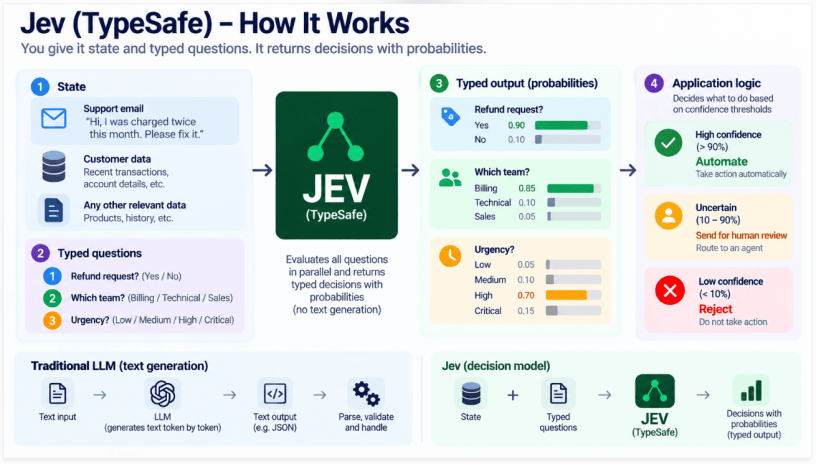
A company called TypeSafe AI has gone the other way with a model named hashtag#Jev. It is built for making decisions inside software and it does not generate text at all. You give it state and questions, and it returns typed decisions with probabilities. Take a support email in the ecommerce platform. You can ask whether it is a refund request, which team should handle it and how urgent it is. Jev answers all three in one request, with a probability on each outcome.
With an LLM we usually go in this sequece: text -> LLM -> generated JSON -> parse -> validate -> application logic.
With Jev it is closer to state -> decision model -> typed output -> application logic.
The output space is defined upfront, so if I give it three possible teams it cannot invent a fourth. It can still be wrong, but the output cannot break the schema.
The second part is calibration. Jev is trained so its probability reflects how often that prediction is actually correct. If it says 80 percent, it should be right roughly 80 percent of the time. That makes the number usable: above 90 percent you automate, in the middle you send for human review, below 10 percent you reject, and you move those lines based on what a wrong decision costs.
The third part is speed. LLMs generate tokens one after another. Jev evaluates its outputs in parallel, and TypeSafe claims response times of 70 to 500 milliseconds and 40 to 200 times the speed of frontier models on this kind of work. I do not think this replaces LLMs. I think it points to a better architecture. So, Jev can take significant role in System 1 work and LLMs for System 2 work where we need reasoning, planning, writing, coding and synthesis.
I believe Jev can become the decision model for System 1work where classification, routing, scoring, filtering, guardrails and deciding when an agent should escalate to a human is crucial. Instead of one large model sitting in the middle of everything, we use different AI primitives for different parts of the workflow.
I write about hashtag#artificialintelligence | hashtag#technology | hashtag#startups | hashtag#mentoring | hashtag#leadership | hashtag#financialindependence
PS: All views are personal
We have built AI around text generation. Jev is taking a different approach.