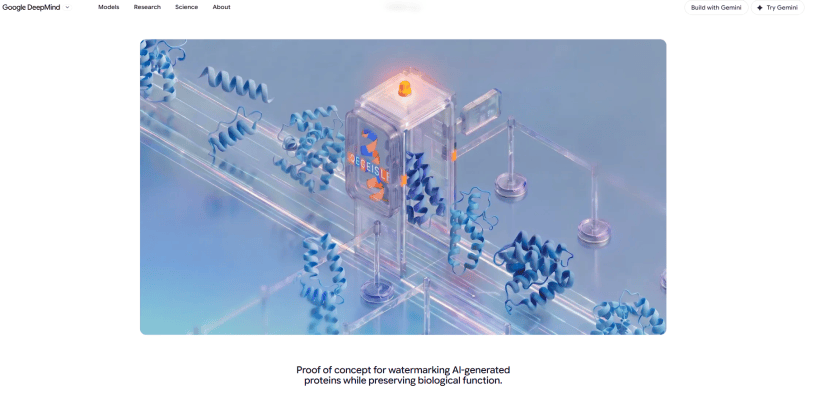
I think one of the most important AI developments this week came from Google DeepMind, and it is not just about discovering new proteins.
DeepMind has introduced SynthID Bio, which puts an invisible watermark into AI-generated protein sequences and predicted protein structures. The interesting part is that the watermark is designed to remain detectable even after the protein is actually synthesized, while preserving its biological function in their tests.
Why does this matter?
AI is moving from predicting biology to actually designing new biology. Models can now create protein sequences that may not exist anywhere in nature. That is incredibly powerful for drug discovery and genetic research. But it also creates a very different security problem. DNA synthesis companies already screen sequences against databases of known biological threats. But if an AI creates a completely new sequence, it may not look anything like something in those databases.
So how do we know where that sequence came from? Was it naturally occurring? Was it designed by a scientist? Was it generated by an AI model? Was it modified after being generated? And more importantly, how do we make sure that increasingly powerful AI systems cannot be used to design biological changes that could cause real harm?
This is why I think DeepMind’s work is much bigger than watermarking. We have spent a lot of time talking about how AI can help us discover new proteins, drugs and genetic therapies. We now need to think equally hard about how we secure what AI creates. The watermark itself is not going to stop a bad actor.
DeepMind is very clear that it is one layer in a broader biosecurity approach. But it can give DNA synthesis providers another signal when deciding which designs need closer review, and it can help establish the provenance of AI-generated biological designs.
I see this as the beginning of a much bigger idea. When AI starts creating things in the
physical world, safety cannot stop at the AI model. We need security around the output of the model as well. And in biology, that may become one of the most important parts of responsible AI.
I write about hashtag#artificialintelligence | hashtag#technology | hashtag#startups | hashtag#mentoring | hashtag#leadership | hashtag#financialindependence
PS: All views are personal
DeepMind has introduced SynthID Bio