I get asked this question quite often.
“Vignesh, I want to learn AI. Where do I start?”
It sounds like a simple question. It isn’t.
There is no shortage of material today. In fact, I think we have reached the opposite problem. There is too much. There are hundreds of YouTube videos, thousands of courses, new models every few weeks, new frameworks every month, and a constant stream of posts explaining why the latest AI technology is going to change everything.
If you are starting today, it is very easy to spend months consuming content and still not have a clear understanding of how everything fits together.
So I started thinking about this differently. Instead of asking “What are the best AI courses?”, I think the better question is: “What should I learn first, what should I learn next, and when am I ready to move forward?”
That led me to a simple three-stage journey.
- Understand the foundations
- Build with AI
- Engineer AI systems
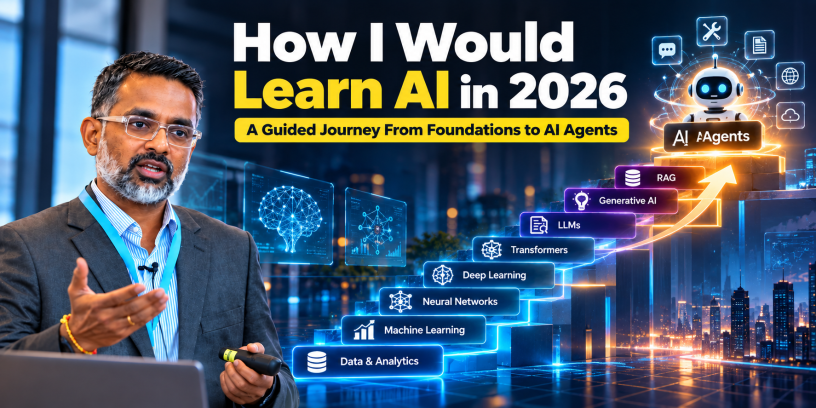
But there is an important difference from the way many AI learning paths are structured. I wouldn’t start with “AI.” I would start with data and analytics, then move into machine learning, neural networks, and deep learning. From there, we can understand transformers, GPT, and LLMs. Only then would I step back and look at the broader world of AI and Generative AI. After that, we move into RAG, agents, agentic AI, and eventually production AI engineering.
The reason is simple. I want the learner to understand the evolution, not just memorize the terminology.
The journey I would follow
The overall journey looks like this:
Data → Analytics → Machine Learning → Neural Networks → Deep Learning → Transformers → GPT / Foundation Models → LLMs → AI → Generative AI → RAG → AI Agents → Agentic AI → Evaluation → Production AI
This isn’t meant to be a strict taxonomy of AI. It is a learning sequence. The objective is to build one concept on top of another. If you already understand some of these areas, skip ahead. You don’t need to sit through material you already know.
Stage 1: Start with data and analytics
Before getting into AI, I would spend some time understanding the thing that sits underneath almost everything in AI: data.
You don’t need to become a data scientist. But you should understand what a dataset is, what a feature is, what a target is, how we identify patterns in data, what prediction means, and how analytics differs from machine learning.
This is particularly important for people coming from business, product, or technology leadership backgrounds.
Analytics generally asks: What happened? Why did it happen?
Machine learning starts moving toward: What is likely to happen? What pattern can we learn from the data?
And modern AI increasingly asks: What can we generate, reason about, or do using what the model has learned?
That progression gives you a much better mental model for the rest of the journey.
Start here
Google Machine Learning Crash Course
This is a good foundation because Google has structured the material into modules covering machine-learning fundamentals, neural networks, embeddings, and eventually modern ML concepts. The course is designed to be hands-on rather than purely theoretical.
You don’t need to become an expert in every algorithm. Focus on understanding the basic lifecycle: Data → Training → Model → Prediction → Evaluation. Once that makes sense, move forward.
Also worth watching
- freeCodeCamp: Machine Learning for Everybody, Full Course (video, a full beginner-to-intermediate walkthrough if you want a single long-form session instead of a modular course)
- StatQuest: A Gentle Introduction to Machine Learning (video, short and very clear on the core vocabulary)
Stage 1 continues: Machine learning
The next step is to understand traditional machine learning properly. Learn the difference between supervised and unsupervised learning. Understand classification and regression. Understand training and evaluation. Understand overfitting. Understand why data quality matters.
Most importantly, understand that a machine-learning model isn’t “intelligent” in the human sense. It learns patterns from data and uses those patterns to make predictions. That understanding becomes very important when we eventually get to LLMs.
Structured learning path
- Google ML Crash Course: Classification
- Google ML Crash Course: Datasets, Generalization, and Overfitting
You don’t have to treat these as isolated courses. Think of the entire Google ML Crash Course as your Stage 1 foundation.
Stage 1: Move into neural networks
Now we get to an important transition. Machine learning can use many different types of models. Neural networks are one particular family of models that became extraordinarily powerful as datasets, computing power, and training techniques improved.
This is where I would introduce: Neural Networks → Deep Learning.
I deliberately put neural networks before deep learning. A learner should first understand what a neural network is before trying to understand why deeper networks are useful.
Structured learning path
The objective isn’t to memorize every activation function. It is to understand the basic idea of layers, weights, representations, and learning.
Also worth watching
- 3Blue1Brown: Neural Networks / Deep Learning series (video playlist, the best visual intuition for how a neural network actually learns that I have come across, worth the full series)
Stage 1: Deep learning
Now we can talk about deep learning. Deep learning is essentially the use of multilayer neural networks to learn increasingly complex representations from data. This is where AI starts becoming capable of handling much more complex problems: computer vision, speech, natural language, and eventually the architectures that power today’s LLMs.
At this stage, you should start understanding the evolution rather than seeing each technology as a completely separate invention. Traditional ML gave us one generation of approaches. Neural networks and deep learning expanded what could be learned. And then the transformer architecture changed the game again.
Stage 1: Understand the transition to transformers
This is one of the most important parts of the journey.
Before LLMs became mainstream, neural networks were already being used extensively for language. There were architectures such as RNNs and LSTMs. Then came attention. And then came transformers. The transformer architecture became one of the foundations of modern LLMs.
Google’s ML Crash Course has a dedicated module on this that explains the architecture and the role of attention.
Structured learning path
I would go through both. Google gives you the more structured technical foundation. IBM gives you a concise conceptual explanation.
The important question at this point is: why were transformers such a big deal? If you can answer that in simple language, you’re ready to move on.
Also worth watching
- 3Blue1Brown: Attention in transformers, visually explained (video, this is the one video I would call essential if you want to actually understand attention rather than just quote the word)
- 3Blue1Brown: But what is a GPT? Visual intro to transformers (video, a natural follow-on that connects attention to how GPT-style models are built)
Stage 1: From transformers to GPT and foundation models
Now we arrive at the transition that led us to today’s AI landscape.
Transformers provided the architecture. Large-scale training provided the capability. GPT demonstrated the power of Generative Pre-trained Transformers. Then came increasingly capable foundation models and LLMs.
This is the point where I would introduce the term foundation model.
Structured learning path
At this point, you should be able to explain the progression from neural networks to deep learning, transformers, and LLMs. You don’t need to know every model released by every company. You need to understand the architecture and the evolution.
Also worth watching
- Andrej Karpathy: Let’s build GPT, from scratch, in code, spelled out (video, this is a genuinely hands-on, code-level walkthrough of building a GPT from the ground up. It is long and technical, so treat it as an optional deep dive once the concepts above feel solid, not a replacement for them)
- If you want more from the same teacher, Andrej Karpathy’s YouTube channel has two other well-known talks worth searching for there: “Intro to Large Language Models” and the longer “Deep Dive into LLMs like ChatGPT.” I’m pointing you to his channel rather than a specific link here since he has re-uploaded and re-cut some of these over time.
Stage 1: Now step back and understand AI
This may seem like an unusual place to introduce the broader concept of AI. But I actually think it works better pedagogically.
You’ve now learned about several technologies that sit inside the broader AI landscape. Now step back. What exactly is AI? What are the different branches? Where do machine learning, deep learning, computer vision, NLP, generative AI, and reinforcement learning fit?
This is when the broader picture becomes much easier to understand. Instead of starting with an abstract definition of AI, you now have some experience with the pieces that make up the field.
Stage 2: Generative AI
Now we enter the part of AI that most people are interested in today: Generative AI.
The learner already understands neural networks, deep learning, transformers, and LLMs. So now the question becomes: what can we actually do with these models?
This is where I would start Microsoft’s Generative AI for Beginners course. Microsoft currently describes it as a 21-lesson course covering the fundamentals of building Generative AI applications.
Structured learning path
I would follow the course in order rather than randomly jumping around. Start with Introduction to Generative AI and LLMs. Then Exploring and Comparing Different LLMs. Then Using Generative AI Responsibly. Then move into Prompt Engineering, Advanced Prompting, and Building Generative AI Applications.
The idea is to move from understanding models to using models.
Stage 2: Learn embeddings
Once you are comfortable working with LLMs, I would introduce embeddings. This is a major conceptual transition.
An LLM by itself only knows what it has learned during training and what you provide in its context. What if you want it to work with your company’s documents, your product documentation, your policies, your customer information, your research? This is where embeddings and semantic search become important.
Structured learning path
Then continue into Microsoft’s vector database and search lessons in the Generative AI for Beginners course. The important concept to understand is: how do we find information that is semantically relevant to a question? Once you understand that, RAG becomes a natural next step.
Stage 2: Learn RAG
Retrieval-Augmented Generation is one of the most important patterns in enterprise GenAI today. The basic idea is simple. Instead of expecting the LLM to know everything, we retrieve relevant information and provide it to the model as context.
The flow becomes: Question → Retrieve → Add context → LLM → Answer.
Structured learning path
- IBM Technology: What Is Retrieval-Augmented Generation (RAG)? (video)
- Google Cloud: Create Generative AI Apps on Google Cloud
At this point, I would stop watching for a while. Build something. Take 20 or 50 documents. Create embeddings. Store them. Retrieve relevant chunks. Send those chunks to an LLM. Build a simple document assistant. Then test it. Ask questions it should answer. Ask questions it shouldn’t answer. Look at what it retrieved.
This is where the learning really begins.
Stage 2: Understand the limitations
Your RAG application will probably fail. That is good.
You might retrieve the wrong information. The answer might not be grounded in the source. The model might hallucinate. The chunks might be too large or too small. The retrieval might be poor.
This is where you start understanding an important principle: the LLM isn’t always the problem. AI applications are systems. The quality of the overall system depends on the data, retrieval, context, model, prompt, tools, and evaluation.
That leads naturally to the next stage.
Stage 3: AI agents
Now we move from systems that answer questions to systems that can take actions.
A simple LLM looks like: Prompt → Response.
RAG looks like: Question → Retrieve → Response.
An agent adds another dimension: Goal → Plan → Use tools → Retrieve information → Act → Continue.
This is a major shift. Microsoft’s AI Agents for Beginners course is a good structured starting point. Its first lesson introduces what agents are, their components, and common use cases.
Structured learning path
Follow the lessons in sequence. Start with understanding what an agent is. Then learn agent design. Then tool use. Then agentic RAG. Then planning. Then multi-agent systems. Then agent improvement. Then production deployment.
This is important because I don’t think people should start their AI journey with agents. An agent makes much more sense once you understand the pieces that an agent is actually orchestrating.
Also worth watching
- IBM Technology: Generative vs Agentic AI, Shaping the Future of AI Collaboration (video, a clean explanation of a distinction people mix up constantly)
- IBM Technology: The Power of AI Agents and Agentic AI Explained (video, a good follow-on once the distinction above makes sense)
Stage 3: Move from agents to agentic AI
Now we go one level deeper. An agent can use tools and take actions. Agentic AI is about designing systems that can handle more complex, multi-step work. That can involve planning, reflection, memory, multiple tools, multiple agents, human intervention, and longer-running workflows.
The distinction isn’t always used consistently across the industry, so I wouldn’t get hung up on terminology. The important thing is the progression: LLM → Tool use → Agent → Planning → Agentic workflow → Multi-agent system.
Microsoft’s newer Agent Framework documentation reflects a similar progression: first create an agent, then add tools, conversation state, memory, workflows, an agent harness, and finally hosting.
Structured learning path
The tutorial itself follows a useful progression: first agent → tools → multi-turn conversations → memory → workflows → agent harness → hosting. That’s exactly the kind of progression I want learners to understand.
Don’t start by building a ten-agent system. Start with one agent. Give it one tool. Understand how it works. Then add complexity only when you have a reason to.
Stage 3: Learn evaluation
This is one of the most important steps in the entire journey.
You’ve now built an agent. How do you know it’s good? You’ve built a RAG application. How do you know your retrieval is good? You’ve changed your prompt. Did the system actually improve?
This is where evaluation becomes critical.
Structured learning path
This is where you start thinking about metrics such as retrieval quality, relevance, groundedness, and answer quality. The mindset changes from “It works on my example” to “I have evidence that the system works across a meaningful set of cases.” That is a huge transition.
Stage 3: Understand enterprise AI
Now I would introduce Databricks. At this stage, the learner already understands the technology. Databricks helps bring in the enterprise perspective.
Its Generative AI Fundamentals course covers what GenAI is, business opportunities, governance, risks, and how to implement secure and grounded GenAI solutions. The course is currently offered free.
Structured learning path
For someone who wants a more hands-on enterprise engineering path, Databricks also has a newer course. It covers building and evaluating RAG pipelines, deploying agents, and using MLflow for GenAI evaluation and tracing.
I would treat this one as an advanced branch, not something everyone needs to complete.
Stage 3: Go deeper into agentic AI
For people who want to go deeper into agentic systems, DeepLearning.AI has a dedicated Agentic AI course, taught by Andrew Ng.
Structured learning path
This is where concepts such as reflection, tool use, planning, multi-agent workflows, evaluation, and production deployment start coming together. At this point, the learner should be able to understand why these patterns exist rather than simply learning them as buzzwords.
Stage 3: Go underneath the applications
Finally, I would bring NVIDIA into the journey. I deliberately put NVIDIA toward the end.
A beginner doesn’t need to understand GPU inference or model serving. But once you’ve built an AI application, the infrastructure becomes much more interesting. You start asking: How fast is inference? How much does each request cost? Can a smaller model do the job? How do I serve models efficiently? How does quantization help? How do I scale inference? How do I monitor an AI system? How do I optimize it?
Structured learning path
This is where I would branch into deeper topics such as inference, model serving, GPU acceleration, quantization, model customization, and LLMOps. Not everyone needs to go this far. But if you want to become a serious AI engineer, this is where the journey gets much deeper.
Also worth watching
- What Is LLMOps? MLOps for Large Language Models Explained in 3 Minutes (video, a fast, plain-language primer before you go deeper into NVIDIA’s material)
What should you actually build?
This is probably the most important part of the roadmap.
Don’t spend six months watching videos. Build alongside the learning.
- After the machine-learning stage, build a simple predictive model.
- After learning neural networks, build a simple neural-network application.
- After learning LLMs, build a basic LLM application.
- After learning embeddings, build semantic search.
- After learning RAG, build a document assistant.
- After learning agents, build an agent with one useful tool.
- After learning evaluation, create a test set and measure your system.
- After learning production AI, deploy and monitor something.
The projects don’t need to be impressive. They need to be just difficult enough to expose what you don’t understand.
And when something breaks, don’t immediately search for another tutorial. Ask: why did it break? That question will probably teach you more than the next ten videos.
The complete guided path
If I had to reduce this entire article to one learning journey that someone could bookmark and follow, I would make it this.
Foundations
- Google Machine Learning Crash Course
- Google ML Crash Course: Neural Networks
- Google ML Crash Course: Transformers and LLMs
- IBM: What are Transformers (Machine Learning Model)? (video)
- IBM: What Are Foundation Models?
- IBM Technology: How Large Language Models Work (video)
- 3Blue1Brown: Neural Networks / Deep Learning series (video playlist)
- 3Blue1Brown: Attention in transformers, visually explained (video)
- 3Blue1Brown: But what is a GPT? (video)
Generative AI
- Microsoft: Generative AI for Beginners
- IBM Technology: What Is a Vector Database? (video)
- IBM Technology: What Is RAG? (video)
- Google Cloud: Create Generative AI Apps
Agents and agentic AI
- Microsoft: AI Agents for Beginners
- Microsoft: Agent Framework
- IBM Technology: Generative vs Agentic AI (video)
- DeepLearning.AI: Building and Evaluating Advanced RAG
- Databricks: Generative AI Fundamentals
- DeepLearning.AI: Agentic AI
Advanced AI engineering
- Databricks: Get Started with Databricks for Generative AI
- NVIDIA: Introduction to LLM Agents
- NVIDIA: AI Developer Resources
You don’t have to follow the whole journey
This is important.
If you’re completely new to AI, start at the beginning. If you already understand analytics and machine learning, start with neural networks and deep learning. If you already understand transformers and LLMs, jump into Generative AI. If you’re comfortable with RAG, start with agents. If you’re already building agents, skip straight to evaluation, governance, observability, and production engineering.
The path is linear. Your starting point doesn’t have to be.
The goal isn’t to say “I know AI”
I don’t think the goal of learning AI should be to eventually say “I know AI.” AI is too broad, and it is changing too quickly for that to mean very much.
The real goal is to reach a point where you can look at a problem and understand what kind of AI approach might make sense. Can I solve this with analytics? Do I need machine learning? Would a traditional model be enough? Do I need an LLM? Would RAG help? Do I need an agent? Should I use one agent or multiple agents? How will I evaluate it? How do I make it secure? How do I monitor it? How do I take it into production?
That is a much more useful definition of learning AI.
For me, the journey is: Understand → Build → Evaluate → Engineer.
Learn the concept. Build something. Break it. Understand why it broke. Improve it. Then move to the next level.
That’s how I would learn AI in 2026.

