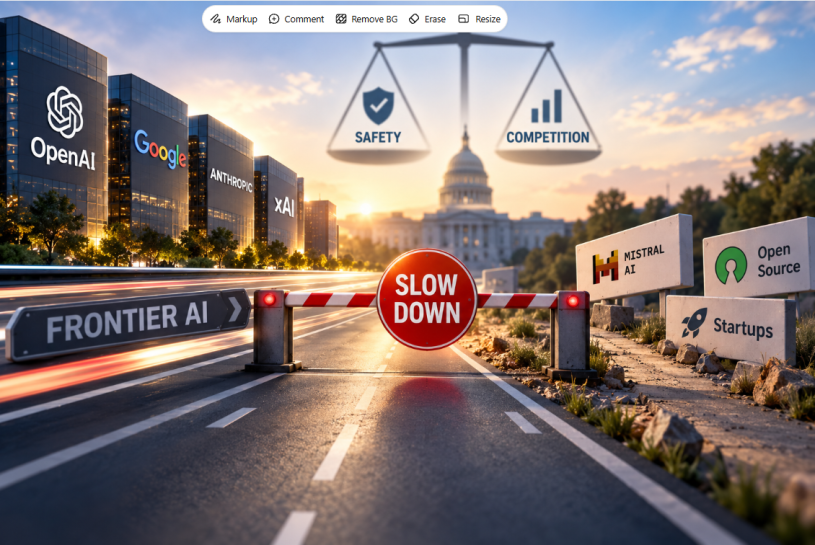
Last week, I asked why the sudden call to slow down Frontier AI development .
I had listed three possible reasons. One of them was a more strategic possibility: could tighter regulation of frontier AI also slow down open-source models and smaller competitors, while making it harder for new players to catch up with the companies already at the frontier?
At that point, I called it as a possibility, but a week later, I find that possibility much more interesting.
European AI companies, including Mistral, are now openly pushing back against the slowdown calls from leading US AI companies. Their concern is that new safety requirements or limits on frontier development could end up strengthening the position of companies that are already ahead and make it harder for others to catch up.
And then yesterday we see a lawsuit filed in the US alleging that Anthropic, OpenAI, xAI and Google coordinated around slowing AI development. These are allegations in a lawsuit, not established facts, so I would not draw conclusions from them. But the fact that this argument has now entered a legal and competitive debate is significant.
This does not mean the safety concerns does not exist. I still believe they are. The recent incidents involving increasingly capable AI agents have shown that our security and control mechanisms need to keep improving. But when the companies developing the most powerful models are also asking for rules that could affect the pace of development, there is another question we should ask.
Who benefits from those rules?
It simply means we should look at both sides of the equation. As someone who works in AI, I actually want stronger safety standards, independent evaluation and better controls. But I also want those standards to be transparent, consistently applied and not become a barrier that only the largest AI companies can afford to cross.
Last week I concluded my note by saying that maybe the real answer was a combination of the three reasons I listed, but the third possibility I raised is no longer just a thought experiment. It has now become part of the public debate around how frontier AI should be regulated and who gets to compete in it.
And that is a conversation I think the AI industry needs to have openly.
I write about hashtag#artificialintelligence | hashtag#technology | hashtag#startups | hashtag#mentoring | hashtag#leadership | hashtag#financialindependence
PS: All views are personal
Why the sudden call to slow down Frontier AI development – continued