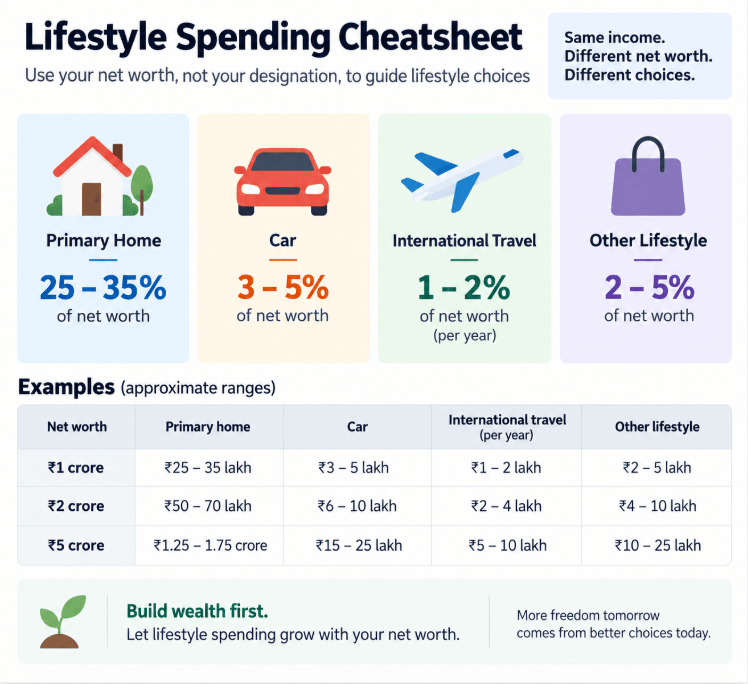
This sounds obvious, but I don’t think most of us actually make lifestyle decisions this way. Take a Director in the technology industry earning around ₹70 lakh a year. Now imagine two people earning the same amount. One has built a net worth of ₹2 crore and the other has ₹5 crore. Their salaries are similar, but I would argue that their lifestyle decisions should be quite different.
If the first person buys a ₹1.2 crore house, 60% of everything they have accumulated is sitting in the house they live in. For the second person, the same house represents 24% of their net worth. The EMI may look affordable to both because they earn the same salary, but the financial impact is very different.
The same logic applies to cars. A ₹20 lakh car is 10% of a ₹2 crore net worth, but only 4% of ₹5 crore. And unlike investments, the car is going to lose value. The latest Autocar India and Spinny study, based on more than 11,000 real-world transactions, found that the average car loses around 21% of its value in the first year and about 41% over five years.
Travel works in exactly the same way. A ₹5 lakh international holiday is 2.5% of a ₹2 crore net worth, but only 1% of ₹5 crore. The question isn’t whether someone can afford the holiday from their salary. The more useful question is what that spending represents compared with everything they have built.
There is no magic formula for this, but I like thinking in ranges. While building wealth, I would be comfortable with a primary home being around 25–35% of net worth, a car around 3–5%, and annual international travel around 1–2%. These aren’t financial rules. They are simply guardrails that help keep lifestyle spending connected to actual wealth.
This also explains why comparing ourselves with someone at the same designation can be misleading. We see another Director buying a BMW, moving into a bigger house or taking several international holidays and assume that we should be able to do the same. But designation and salary don’t tell us what that person’s balance sheet looks like.
Someone may earn ₹70 lakh and have accumulated ₹2 crore. Someone else may earn the same ₹70 lakh and have accumulated ₹8 crore. Their income is the same, but their financial capacity is not.
I think this becomes increasingly important in our 40s. The question is no longer just how much we earn. It is how much we have built and how much of that wealth we are converting into lifestyle.
Before making the next big purchase, perhaps the useful question is not “Can I afford the EMI?” but “What percentage of my net worth am I putting into this?”
That one question can change the way we look at a house, a car, a holiday or even a lifestyle upgrade.
I write about hashtag#artificialintelligence | hashtag#technology | hashtag#startups | hashtag#mentoring | hashtag#leadership | hashtag#financialindependence
PS: All views are personal
Your designation should not decide what car you drive. Your net worth should.