Thinking about buying the latest iPhone on your credit card and paying it off later?
I used to think my dad was using credit cards wrong.
When I started my first job, I would argue with him about why he always paid the entire credit card bill. My thinking was simple. If I can buy something expensive today and pay a smaller amount every month, why not? I can keep the rest of my money with me and pay the credit card over time. I thought that was the whole point of having a credit card.
My dad never agreed. He would always pay the full outstanding amount. At that time, I thought he was being overly cautious. It took me a few years to understand what I was missing.
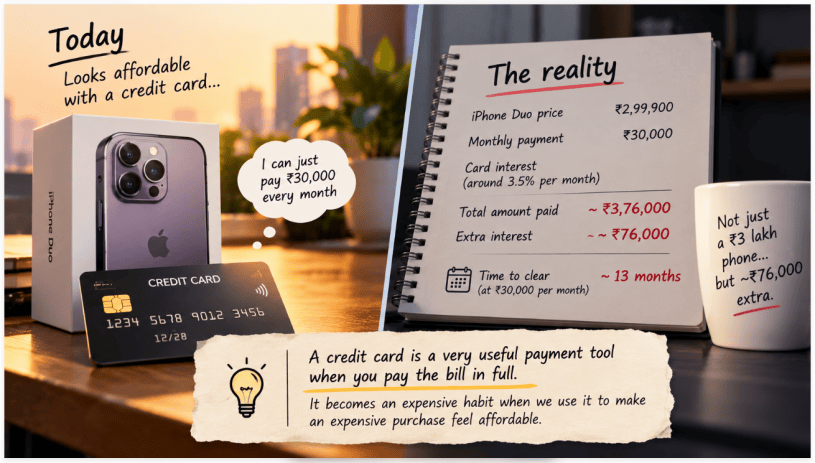
Take the new iPhone Duo. The starting price in India is ₹2,99,900. If I really want the phone but don’t have ₹3 lakh available, it can be very tempting to put it on a credit card and tell myself, “I can manage ₹30,000 a month.”
But suppose the card charges around 3.5% interest a month. Even paying ₹30,000 every month, that ₹2,99,900 balance would take about 13 months to clear. I would end up paying roughly ₹3.76 lakh, including around ₹76,000 in interest, before considering GST and other charges.
So I haven’t just bought a ₹3 lakh phone. I have paid another ₹76,000 simply because I didn’t pay for it when I bought it.
All of a sudden, the phone looks very different from the initial value proposition.
The problem is that when we look at the credit card statement, we don’t think about the ₹3 lakh purchase anymore. We look at the amount we can comfortably pay that month.
And this is where I think I was naive when I started working. I was confusing the ability to borrow with the ability to afford something.
My dad understood something I didn’t. A credit card can be a very useful payment tool when you pay the bill in full. But using it to make an expensive purchase feel affordable by spreading the payment can become an extremely expensive habit.
Looking back, I wasn’t really leveraging the credit card. I was borrowing money at a very high cost and calling it financial flexibility.
Thankfully, I understood it pretty early in my career and started paying my credit cards in full. The simple rule we follow at home today is this: a credit card is just another payment option. We don’t swipe it if we cannot pay the full bill.

