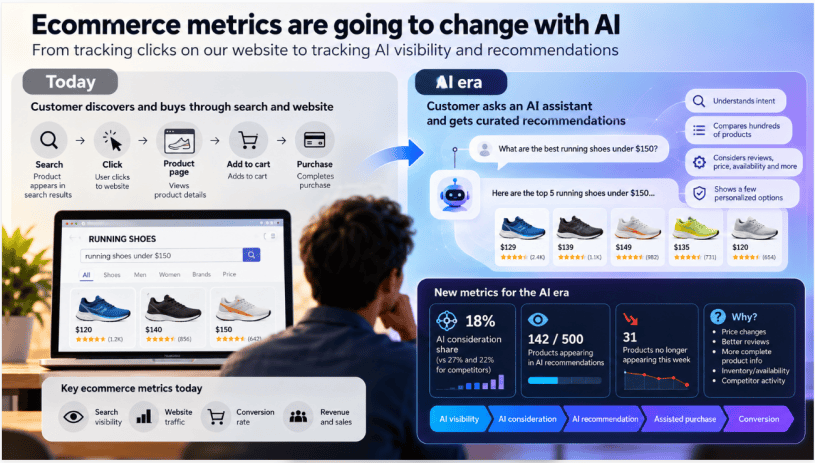
Ecommerce metrics are going to change when AI becomes part of the buying journey.
For years, we have measured ecommerce through a fairly familiar funnel. How many people saw the product, clicked on it, viewed the product page, added it to the cart and eventually purchased it.
Then came search and it became a major part of the equation. We started measuring where our products appeared in search, how much traffic they generated and how often customers clicked through.
But what happens when AI starts doing more of the product discovery and comparison for the customer?
Imagine a customer asking an AI, “What are the best running shoes under $150?”
The AI may compare hundreds of products and return five recommendations. The customer may never see the other products, never visit their websites and never know they existed.
So now the ecommerce teams will have to measure something very different.
How often is my product being considered by AI? How often does it actually appear in recommendations? How does that compare with competitors? Which of my SKUs are gaining visibility and which ones are disappearing?
Imagine a dashboard showing that your AI consideration share is 18%, while Competitor A is at 27% and Competitor B at 22%.
You have 500 products in your catalog, but only 142 are appearing in relevant AI recommendations. 31 products that were visible last week are no longer appearing.
Now the interesting question becomes: why?
Did a competitor become more competitive on price? Do their products have better reviews? Is their product information more complete? Did your inventory or availability change?
This starts creating a completely different measurement loop for ecommerce.
Today most of the ecommerce platforms look at search visibility -> traffic -> conversion.
With AI we may need to look at AI visibility -> AI consideration -> AI recommendation -> assisted purchase -> conversion.
And I think this could change how decisions and strategies are defined by ecommerce teams about performance.
The website may still be where the transaction happens, but the decision about which products the customer sees may increasingly happen somewhere else.

