I believe that AI agents can fundamentally change ecommerce, not just improve it.
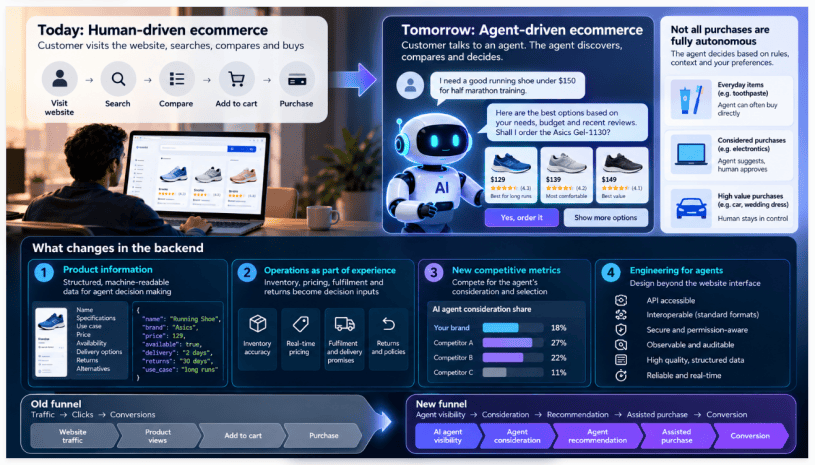
In today’s model the customer visits the website, searches, compares and buys. With AI agents, I see a different journey emerging. The customer talks to an agent, and the agent does the discovering, comparing and deciding. Sometimes it brings options back to the customer. Sometimes it just buys.
The interesting part is not the agent itself. It is what happens to the entire ecommerce Product and Engineering stack when the person deciding is no longer directly interacting with it. Every system we have built to date assumes a human will interact with it. What happens if the website is no longer the primary interface?
That changes many of the underlying building blocks:
- Product information needs to be structured and machine-readable, so an agent understands what we sell, who it is for, price, availability, delivery, returns and alternatives. Product data stops being catalogue data and becomes part of the decision-making layer.
- Operations shifts the same way. Inventory accuracy, pricing, fulfilment, delivery promises and returns become inputs into a purchase decision when an agent is comparing twenty products. Operations becomes part of the product experience.
- And then the key shift: today we compete for traffic, traffic turns into clicks, and clicks turn into conversions. In an agent-mediated world, we may increasingly compete for the agent’s consideration/attention and selection. The question stops being how do I get the customer to my website, and becomes how do I get the agent to choose me.
Add another complexity on top of this, where every purchase might not become fully autonomous. Reordering toothpaste is very different from buying a car or a wedding dress. So the Product challenge needs to factor this and becomes one of delegation.
- What can the agent decide?
- Where does a human need to stay in the loop?
- How much can it spend?
- Can the action be reversed?
- Can we explain why it made that decision?
From an Engineering side, this means designing beyond the interface. Ecommerce systems need to be machine-readable, API-accessible, interoperable, secure, observable and permission-aware.
The biggest mistake would be treating agentic commerce as just another feature. It looks more like a change in the interaction model of ecommerce itself.
We spent two decades building ecommerce for humans. Now we need commerce that works for humans and for the agents acting on their behalf.

