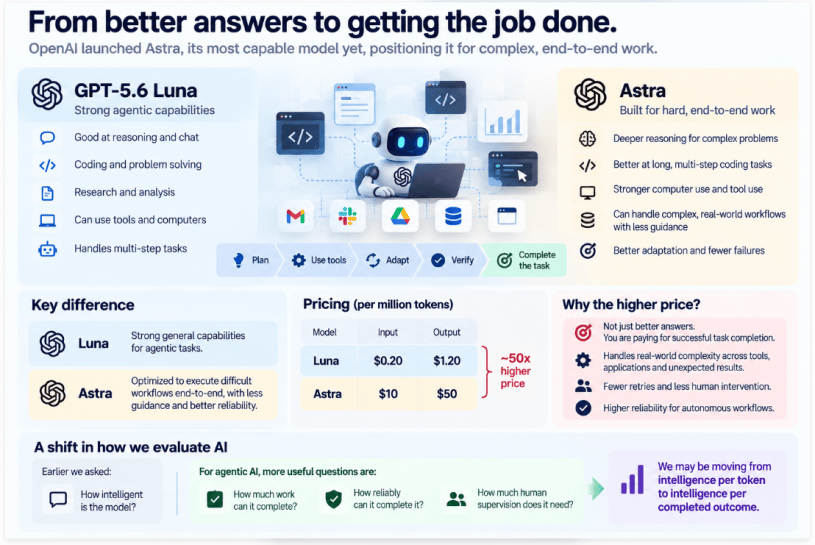
OpenAI launched Astra on September 3, and are calling it its most capable model yet.
The claim isn’t simply that it gives better answers. OpenAI is positioning Astra for hard, end-to-end work: complex reasoning, coding, computer use, research and multi-step professional workflows.
And from complex enterprise usecases, this distinction is significant according to me.
But, I find GPT-5.6 Luna already has strong agentic capabilities. It is not that Astra suddenly is taking AI agentic. The claim is that it can execute difficult workflows with less guidance, better adaptation and fewer failures.
And the industry reaction is a mixed bag.
Some see Astra as a major step toward AGI. Others are more cautious, arguing that benchmark gains don’t automatically translate into reliable autonomous work.
What caught my attention is the pricing.
Astra: $10 / $50 per million input/output tokens
Luna: $0.20 / $1.20
That’s roughly a 50x price difference. It would be naive to expect Astra to be 50x better at answering questions. For me, I think the premium pricing is for getting the job done.
Consider an agent working across applications. It has to reason through the task, use tools, deal with unexpected results, change direction and verify its output. In that world, the economics aren’t really about tokens anymore. They are about successful task completion.
A cheaper model that needs repeated retries and human intervention may be more expensive than a costly model that completes the workflow reliably. That is the bet I see OpenAI taking with Astra.
And it leads to a bigger shift in how we might be evaluating AI in the future.
Traditionally we have have been asking: How intelligent is the model?
I think for agentic AI, the more useful questions are: How much work can it complete? How reliably can it complete it? How much human supervision does it need?
If Astra can materially improve those numbers, the premium starts to make sense, else for me Luna remains the better economic choice for a large class of workloads.
May be we are slowly moving from intelligence per token to intelligence per completed outcome.

