For the last few years, most of the conversation around AI has been about capability. How powerful the models are, how fast they are improving, and what new features they can unlock.
But if we step back, the real question for AI adoption was always going to be something else. Can we trust it?
Over the past three years, a lot of people outside the tech ecosystem experienced AI in a meaningful way for the first time. The excitement was real. For many, it felt like a sudden leap in technology. Inside the tech community, we knew that this progress had been building for years through machine learning and deep learning.
Now that the initial excitement is settling, the questions are changing. As AI moves from experiments into real-world use, people are starting to ask more practical questions. If I use an AI assistant, how much of my personal life does it see? What happens to my data? How much access should I really give a digital assistant into my life?
No one is comfortable with the idea of a system that has unlimited access to their private information without clear guardrails. This is why trust and ethics will become one of the biggest differentiators in the AI ecosystem.
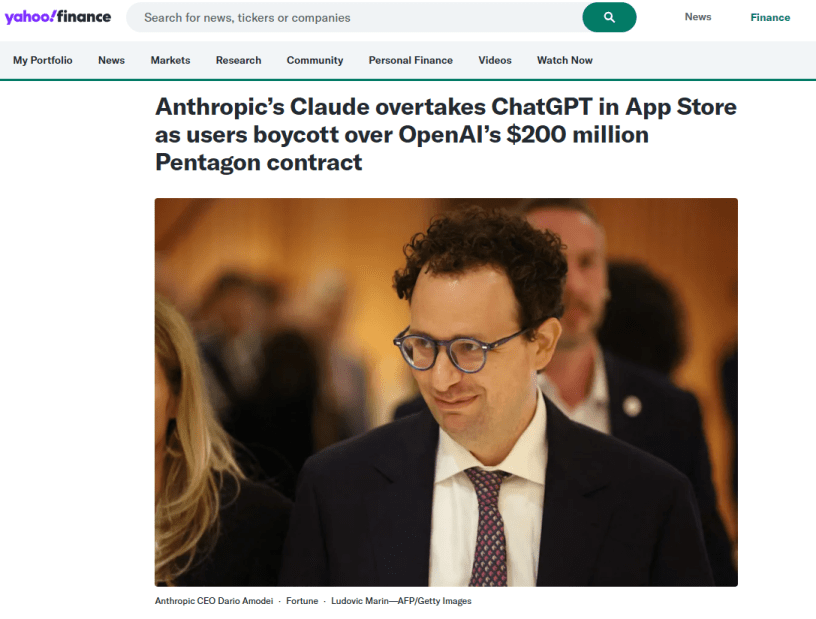
A small but interesting signal of this shift came recently when Anthropic’s Claude briefly overtook ChatGPT to reach the number one position on Apple’s U.S. App Store. App rankings change all the time, so the ranking itself is not the point. What makes it interesting is the timing. It happened when conversations around AI partnerships, governance, and responsible deployment started getting more attention.
Most users may not fully understand the technical differences between models. But they do notice signals around trust. How companies talk about safety. How transparent they are about data. Where they draw the line when it comes to sensitive use cases.
In many ways, technology brands have always been built this way. Not just on capability, but on the confidence users place in them.
The companies that win in the long run may not always be the ones with the biggest models or the fastest releases. They will be the ones that build credibility with users and show that they are willing to make responsible choices, even when those choices are not the easiest ones commercially.
AI will eventually become deeply integrated with human workflows and decision making. But that level of integration will only happen if people feel comfortable allowing these systems into their daily lives.
I write about hashtag#artificialintelligence | hashtag#technology | hashtag#startups | hashtag#mentoring | hashtag#leadership | hashtag#financialindependence
PS: All views are personal
What can we learn from the recent Anthropic and OpenAI episode?
 Vignesh Kumar