When we talk about financial independence, most conversations revolve around savings rate, compounding, equity exposure, and long-term growth. All of that matters. But there is one layer that many people ignore while planning. Geo political risk.
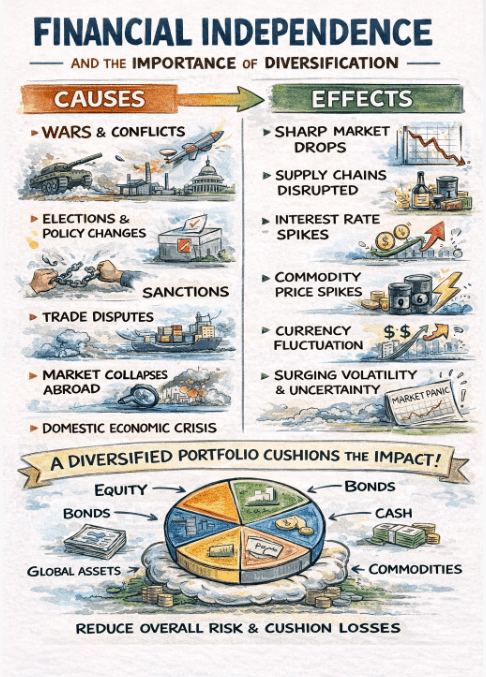
We are living in a time where global equations are constantly shifting. Wars and regional conflicts disrupt supply chains. Elections change policy directions overnight. Trade tensions influence currency movements. Sanctions impact commodities. Interest rate cycles respond to inflation triggered by events far beyond domestic borders. None of these are theoretical risks. They are happening in real time.
👉 Now think about what that means for your investments.
Equity markets react sharply to uncertainty. A single escalation can wipe out months of gains in a few days. Sectors linked to global trade, energy, or technology can swing widely based on policy decisions made thousands of kilometres away. Currency fluctuations can affect international funds. Bond yields move when central banks adjust rates in response to global stress. Commodities spike during conflict and crash when stability returns.
If your entire financial independence plan assumes that markets will remain stable and steadily climb upward, you are building on a fragile base.
This is precisely why diversification is not a textbook concept. It is a survival strategy.
A diversified portfolio spreads risk across asset classes that do not react the same way to the same event. When equities fall due to global uncertainty, high-quality debt instruments may provide stability. When inflation rises because of geopolitical disruptions, certain real assets or commodities may act as a hedge. When domestic markets struggle, exposure to global assets can sometimes balance the impact. Cash or near-liquid instruments provide optionality during volatile periods.
Diversification does not eliminate risk. It cushions shocks.
Financial independence is a long journey. Over that journey, there will be wars, recessions, policy shifts, technological disruptions, and black swan events. The goal is not to predict them perfectly. The goal is to design a portfolio that can withstand them.
Dumping everything into markets because they have historically delivered strong returns is not a strategy. It is an assumption. And assumptions do not protect wealth.
If you are serious about financial independence, spend as much time thinking about risk management as you do about returns. Build a portfolio that is designed to survive volatility, not just benefit from bull runs.
I write about hashtag#artificialintelligence | hashtag#technology | hashtag#startups | hashtag#mentoring | hashtag#leadership | hashtag#financialindependence
Financial independence is not just about returns. It is about resilience
 Vignesh Kumar