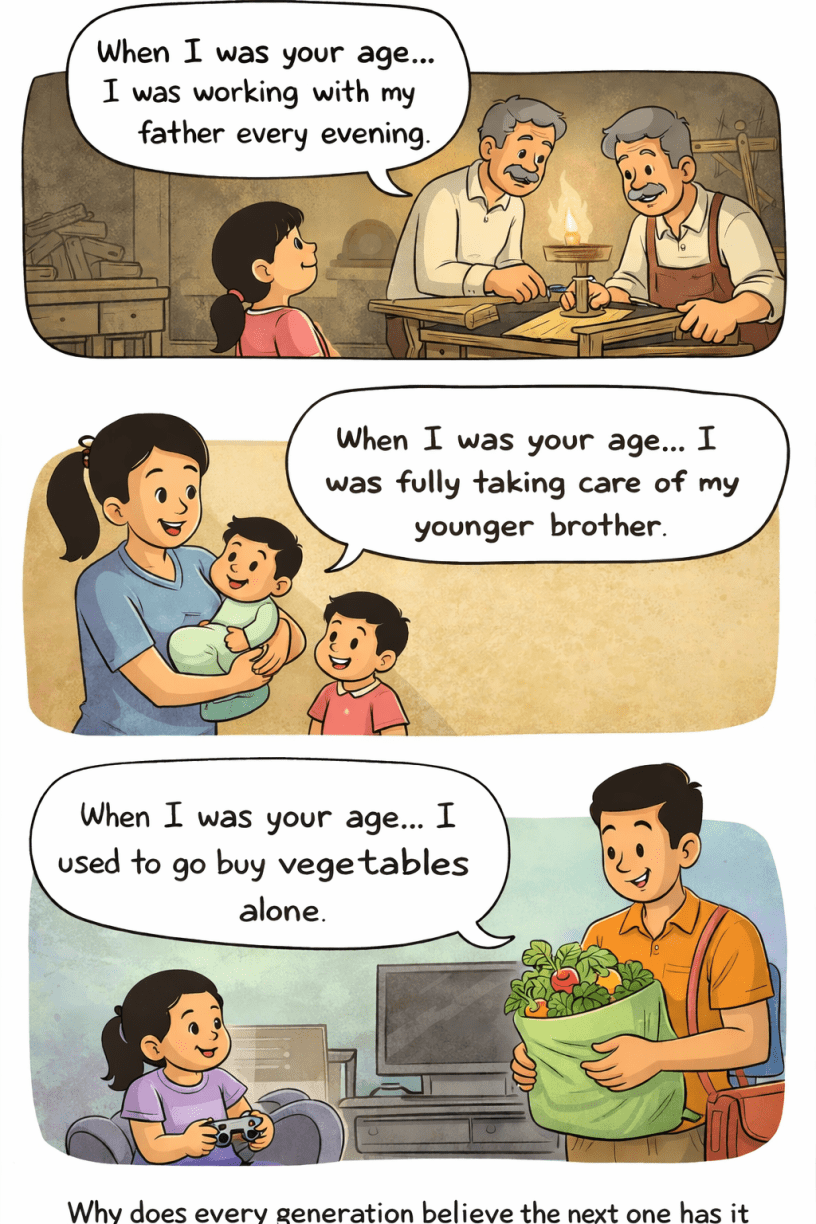
My grandfather used to tell my mother that at her age he was already working in the evenings with his father. My mother told me that when she was ten, she was fully taking care of her younger brother. And now I find myself telling my daughter that when I was her age, I used to go alone to buy vegetables.
The script does not change. Only the characters do.
Over the past couple of years, I have struggled with my daughter on this more than once. When she reacts strongly to something or resists a responsibility, my instinct is to explain how things were for me at her age. I talk about what I handled. The independence I had. The things I managed.
But slowly it is dawning on me that my circumstances are not something she can resonate with. Her world is fundamentally different. The pressures she faces are different. The exposure she has is different. Even the risks we protect her from are different. I am comparing effort without comparing context.
Part of this is psychological. We remember our struggles clearly because they shaped us. Hardship becomes part of our identity. When we do not see the same visible hardship in the next generation, we assume they are more pampered or entitled. But maybe we are simply projecting our own benchmark of strength onto a different environment.
There is also a structural shift. Each generation grows up in a different economic and social reality. In earlier decades, especially in India, children contributed to survival. Today, children are protected so they can prepare. That shift can look like comfort, but it is also progress.
The same thinking appears in corporate life. Senior leaders often say they worked longer hours, tolerated more hierarchy and faced more constraints. Younger employees expect flexibility, clarity and balance. Instead of asking who is tougher, perhaps we should ask whether the environment itself has changed.
Maybe leadership, whether at home or at work, requires us to evaluate the next generation in the context they operate in, not the one we grew up in. Strength does not disappear when circumstances change. It simply expresses itself differently.
I am still learning this with my daughter. And that realization has been more humbling than any comparison I have made.
I write about hashtag#artificialintelligence | hashtag#technology | hashtag#startups | hashtag#mentoring | hashtag#leadership | hashtag#financialindependence
PS: All views are personal
👉 Why does every generation believe the next one has it easier?
 Vignesh Kumar