I have often spoken about why Vibe coding works well for prototypes but struggles beyond that stage. It is fast, visually impressive, and gives the feeling that you are building software in minutes. But once you move beyond that first version, things start to get complicated. When you try to add new features, integrate complex business logic, or scale to production, the cracks begin to show.
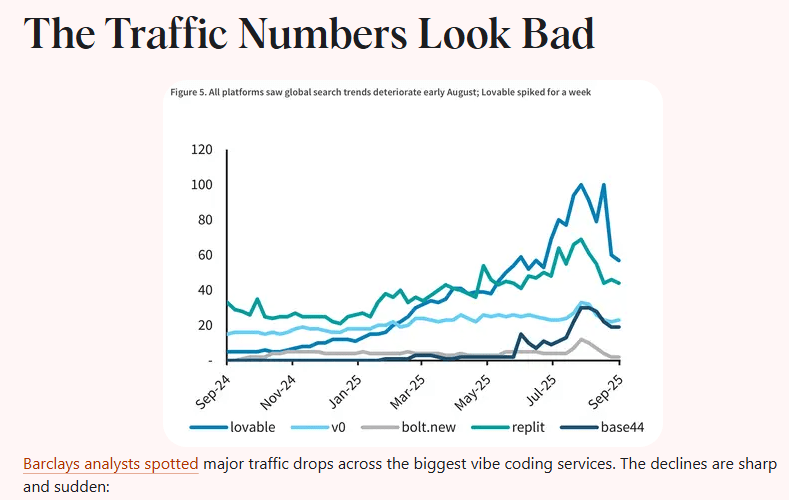
A recent research report confirms this shift. Traffic to leading Vibe coding tools has dropped sharply. Lovable is down by 40 percent, Bolt.new by 27 percent, and Vercel’s v0 by nearly 64 percent. The reason is simple. These tools were never built for enterprise-grade software. The code they generate often lacks structure, layering, or consistent standards. What you end up with is spaghetti code that looks fine at first but becomes almost impossible to debug or extend.
In real-world projects, this leads to three major problems:
1️⃣ Maintainability, because most of the code is auto-stitched without structure or documentation.
2️⃣ Scalability, since the generated logic is not optimized for performance or modular reuse.
3️⃣ Security, as quick automation often skips over data protection and access control fundamentals.
We now have platforms like Woz are approaching the problem differently. Instead of generating everything from scratch, Woz builds using pre-tested production components for core layers such as payments, authentication, and data access. These components are standardized, versioned, and audited. Human engineers oversee the assembly, validate integrations, and review code before it goes live. This ensures that applications are not just functional but maintainable, secure, and production-ready.
You might as – “Vignesh this looks similar to what we did with microservices or containers”?.
There is a subtle yet significant difference, Microservices lived at the infrastructure and backend level, where the focus was on service boundaries, APIs, and deployment pipelines. What Woz is doing sits much higher, at the UX and application composition layer. Here, modularity is abstracted around user experience and functional capabilities rather than system architecture. The goal is not container orchestration but experience orchestration, assembling production-ready apps from secure, reusable building blocks.
Technically, Woz operates like a software assembly line. It uses reusable components that guarantee consistency and enforce best practices by design.
To me, this was the natural next step. The industry is moving from “prototype quickly” to “deploy reliably.”
🚀 The hype around Vibe coding is starting to fade, and the numbers clearly show it.
 Vignesh Kumar