Post-purchase is one of the busiest touchpoints in eCommerce. Customers ask things like:
👉 “Where is my order?”
👉 “How do I return my headphones?”
On the surface, these look simple. But to under the hood, orchestration of these questions are very different.
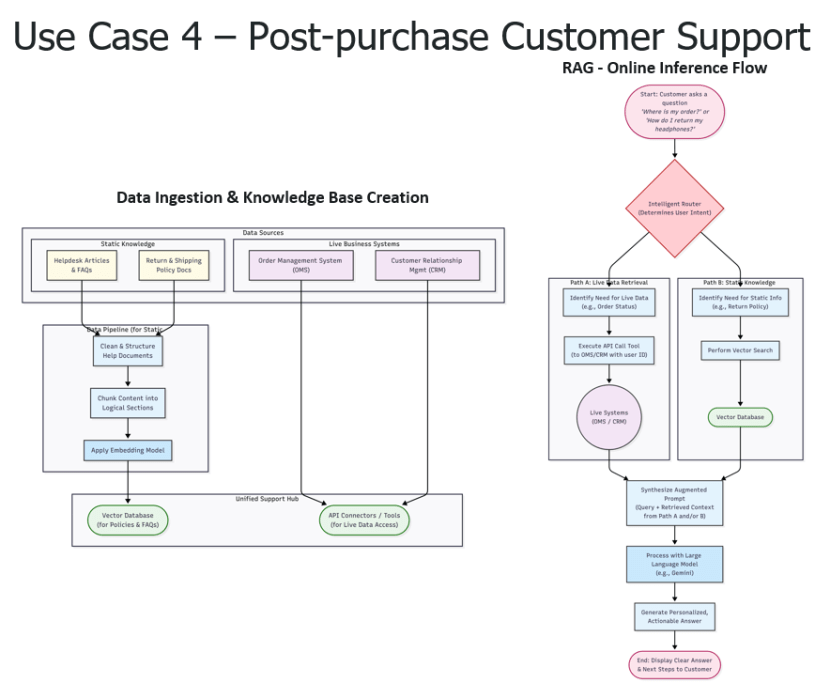
1) Which requires Live data (like order tracking, delivery date, payment status)
2) That require Static knowledge (like return policy, warranty terms, FAQs)
Most support bots struggle here because they don’t know when to pull live updates vs when to fall back on static documents. This is where RAG (Retrieval Augmented Generation) adds real value.
Policies and FAQs are cleaned, chunked, embedded, and stored in a vector database. Order status and account details come via secure API calls to live systems like OMS or CRM. An intelligent router first identifies whether the user’s intent needs live data or static information, and then combines the right context to feed into an LLM. The result is a clear, personalized, and actionable answer to the customer.
We’ve already seen what happens when this isn’t done right. Last year, Air Canada’s chatbot gave a customer wrong information about bereavement fares. The passenger relied on it, booked tickets, and later discovered the info was incorrect. Air Canada tried to argue that the chatbot was a “separate entity.” The court disagreed and ruled that the airline was responsible. This is exactly the kind of failure that happens when bots are not grounded in official sources. With RAG, the system would have pulled the verified policy from its knowledge base, avoiding both reputational and financial damage.
The key areas that you would need to get this correct is: proper document chunking to ensure the right policy is retrieved, secure API connectors for live data queries, and intelligent routing to prevent hallucinations in customer support. When done well, the business benefits are clear: faster and more accurate answers reduce the load on agents, customers get clarity instantly which builds trust and loyalty, and businesses avoid costly mistakes, legal risks, and brand damage.
Post-purchase support is no longer just about answering tickets faster, it’s about answering them right with the correct context. With RAG, businesses can finally connect policies and live systems into one intelligent support layer. Remember, when this is done poorly, it risk misleading customers and damaging trust and when done right, RAG turns customer support from a cost center into a trust-building advantage.
🔎 RAG Use Case 4 – Post-purchase customer support
 Vignesh Kumar