I’ve been trying to analyze this by going through the information available online. These two recent launches have brought quantum computing into focus. Here’s my take on it—let me break it down in the simplest way possible.
Quantum computing is evolving fast, and two companies—Microsoft and Google—are taking different approaches to solve a key problem: reducing errors and scaling qubits.
🔹 Microsoft’s Majorana
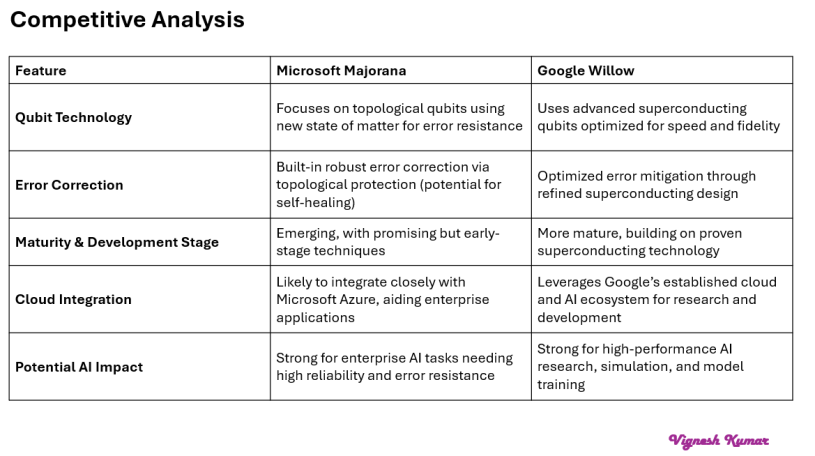
Microsoft is working on a new state of matter to build more stable qubits. These Majorana zero modes could make qubits that resist errors on their own—like a lock that fixes itself if someone tries to pick it. If they can make this work at scale, it could lead to more reliable quantum computers. But this approach is still in its early stages, and controlling these states remains a challenge.
🔹 Google’s Willow
Google is refining superconducting qubits, which is a more established approach. Think of Willow as a high-performance sports car—it doesn’t change the fundamentals but focuses on improving speed and precision. Google is optimizing what already works, which might make it easier to bring to market.
If I am getting this correct, both chips have the potential to help speed up AI tasks that are too complex for traditional computers.
👉 Majorana’s error resistance could help build more reliable AI systems on Microsoft Azure.
👉 Willow’s performance improvements could accelerate AI model training in Google’s cloud.
⚙️ The next question that you might have is – Which One Will Succeed?
It’s hard to predict this at this point. Microsoft’s approach is more experimental—if it works, it could set a new direction for quantum computing. Google’s approach builds on proven methods, so it might be easier to bring into real-world applications sooner.
Either way, what I am happy about is that, both are steps toward making quantum computing useful for AI. It will be interesting to see how this plays out in the coming years.
🚀Microsoft’s Majorana vs. Google’s Willow: Which approach will shape the future of quantum computing?
 Vignesh Kumar