As we all know, scientific breakthroughs take years—sometimes decades—of research, testing, and validation. But what if AI could cut this time drastically?
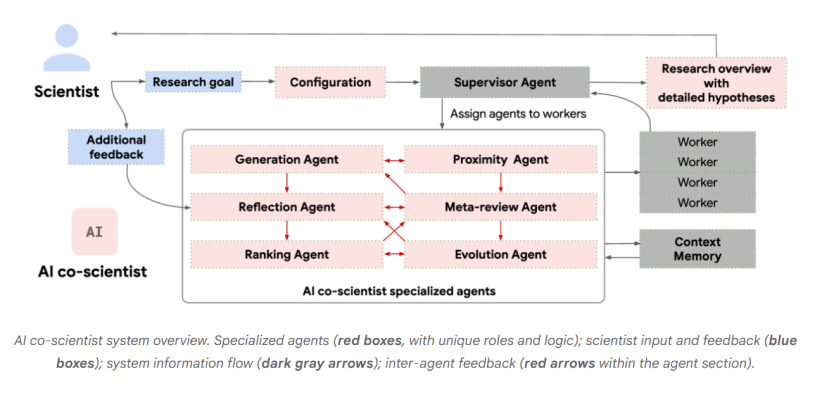
Meet AI #CoScientist, a multi-agent system built on #Google #Gemini 2.0. Designed to augment human researchers, this AI doesn’t just summarize papers or predict outcomes—it generates, debates, and evolves scientific hypotheses.
👉 AI Co-Scientist follows a structured, multi-agent approach that mirrors the scientific process:
◾ Generation Agent: Proposes new research hypotheses based on existing literature and knowledge gaps.
◾ Reflection Agent: Acts as a scientific reviewer, critically evaluating hypotheses for validity and novelty.
◾ Ranking Agent: Conducts AI-driven “tournaments” to compare hypotheses and identify the most promising ones.
◾ Evolution Agent: Improves ideas by refining them, integrating new findings, and eliminating weak assumptions.
◾ Meta-Review Agent: Synthesizes insights across reviews to create high-quality research proposals.
👉 And how is this already helping scientists?
Recently, Professor José Penadés from Imperial College London spent a decade researching how superbugs develop resistance to antibiotics. He tested Google’s AI Co-Scientist by asking it the same core question.
🚀 The result? The AI reached the same conclusion in just 48 hours—a problem that took microbiologists years to solve.
Even more impressive, AI Co-Scientist proposed four additional hypotheses, one of which the team had never considered and is now actively investigating.
This isn’t just about speed—it’s about expanding human potential. Scientists still lead the way, but AI Co-Scientist removes years of trial and error, allowing experts to focus on high-value research.
Beyond microbiology, AI Co-Scientist has provided a few solutions to some compelling healthcare problems:
💠 Proposed new drug candidates for acute myeloid leukemia, later validated in lab experiments.
💠 Identified novel treatment targets for liver fibrosis, showing potential for regenerative medicine.
💠 Discovered a new bacterial gene transfer mechanism, accelerating research in antibiotic resistance.
Many say AI is about digital tasks, but the real transformation is happening in our physical world—healthcare, drug discovery, material science, and more.
And trust me, we are just getting started. AI-powered discovery will only get faster and smarter in the coming years. What once took decades could soon take weeks.
Read complete article: https://research.google/blog/accelerating-scientific-breakthroughs-with-an-ai-co-scientist/
 Vignesh Kumar