What SamAltman shared about OpenAI’s roadmap is a classic example of how a company stays relevant by continuously innovating. It’s also a great use case for product managers—on how to shape a product from the customer’s perspective.
Let’s first look at the key facts:
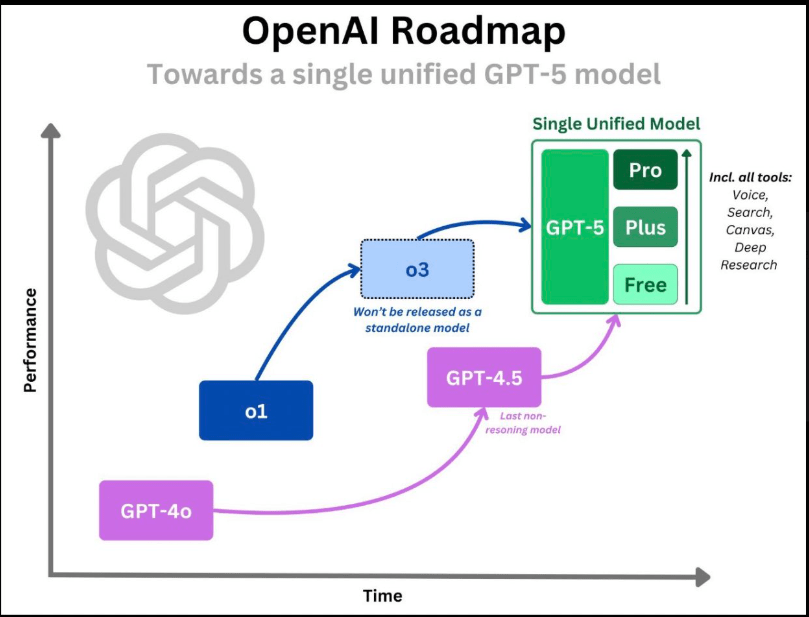
◾ OpenAI is moving towards a unified GPT-5 model—combining both reasoning and non-reasoning/generative capabilities.
◾ GPT-4.5 will be the last in the series of non-reasoning models.
◾ O3 (reasoning model) will not be a standalone model.
👉 Now, why is this roadmap significant?
1️⃣ Product Simplification: Reducing Customer Confusion
When a company offers too many similar products or variants, it does more harm than good. Instead of helping customers, it confuses them. A user faced with too many choices either spends too much time deciding or feels frustrated if their choice doesn’t give the expected results.
Today, when we log into ChatGPT, we see 8-10 model choices. While AI professionals may understand which model to use, general users find it confusing.
🌟 OpenAI’s first move: Simplify the product. With GPT-5, users don’t need to worry about picking the right model—the system will handle it.
2️⃣ A Unified, Smarter AI: Intelligent Model Routing
AI is evolving fast, and real-world applications require a combination of models—some for generative tasks and others for reasoning-based deep thinking. GPT-5 brings all of these under one hood. Instead of users picking a model, an AI-powered LLM Router will automatically route queries to the most suitable model.
Example: A query like “What is the capital of India?” doesn’t need the same model that solves complex mathematical equations.
🌟 OpenAI’s second move: Provide a unified product that intelligently optimizes performance, accuracy, and cost.
3️⃣ A Clean & Effective Monetization Model
They’ve restructured their pricing into a freemium model, which will likely be:
◾ Free Tier: Designed for casual users (who might have considered switching to DeepSeek due to cost). They get limited access (either in features or daily prompts) but stay on the platform, experiencing the latest features.
◾ Plus & Pro Tiers: Where OpenAI monetizes. Serious users will pay for reliability, performance, and premium features, as real-world AI use cases are not just about cost.
◾ This follows the classic “Good-Better-Best” (GBB) pricing model.
Only time will tell how successful this roadmap will be, but from my perspective, OpenAI is making the right moves. I’m curious to see how they will price the Plus and Pro tiers. However, with ongoing architecture innovations, I predict the pricing will be highly competitive.
I’ll stick my neck out and say:
🚀 “OpenAI might have got this right.”
🚀 Do You Understand the Significance of OpenAI’s Future Roadmap?
 Vignesh Kumar