I have been saying this for the past one to two years, and I’m glad we are already seeing many successful AI healthcare use cases.
All the investments in AI can be justified even if it was only for #AlphaFold – an AI model that predicts 3D protein structures. Its impact is so significant that, for the first time, we now have the ability to deeply analyze proteins, the building blocks of life. I’ll write a separate post on this because understanding its potential can truly change how we approach human health.
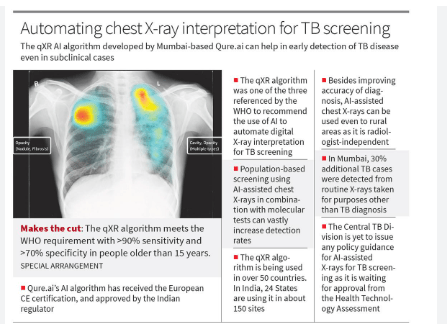
👉 But today, I want to highlight another AI success story from India—the AI-powered handheld X-ray machine that enables early detection of tuberculosis (TB).
Developed by #IITKanpur and #ICMR, this AI-powered device costs less than half of imported machines, making large-scale TB screening more accessible and affordable.
Traditional sputum tests or chest X-rays require experienced radiologists and technicians. The shortage of healthcare professionals has always been a challenge, making early detection difficult to scale.
This is where AI makes a difference.
The new AI-powered machine automates and speeds up the process:
💠 Step 1: Portable Screening – The handheld X-ray device scans the patient’s chest, making it usable in rural areas, mobile health camps, and field locations.
💠 Step 2: AI Analysis – The AI processes the X-ray image using models (most probably leveraging Convolutional Neural Networks #CNN) trained on thousands of TB-positive and TB-negative cases.
💠 Step 3: Immediate Detection – The AI identifies signs of TB infection, analyzes lung patterns, and classifies the severity.
💠 Step 4: Doctor’s Validation – The AI-generated report is reviewed by doctors (looks like #EdgeAI), who decide on further testing or immediate treatment.
This technology reduces dependence on radiologists, speeds up TB detection, and helps reach vulnerable populations faster.
👉 And, we are already seeing this technology in action. At the Mahakumbh, one of the world’s largest human gatherings, this AI-powered X-ray device is being used for TB screening. Although we are currently testing only a sample of attendees, this marks the beginning of a future where AI enables large-scale early disease detection at a speed never possible before.
This is a perfect example of how AI will transform healthcare. AI is not here to replace humans—it is here to be our tireless virtual assistant, handling data-heavy tasks, analyzing complex patterns, and delivering actionable insights to support human decision-making.
🚀 I strongly believe that – “AI’s biggest potential lies in healthcare”
 Vignesh Kumar