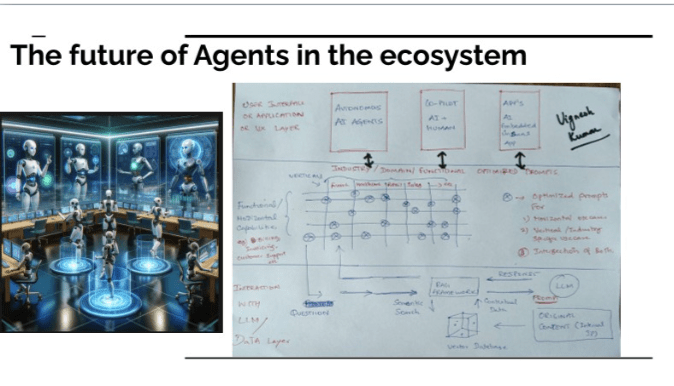
A couple of months ago, I presented this at the Huddle – Kerala Startup Mission event. AI is changing so fast that the slides already need an update!
The focus of my talk was simple – how AI agents are shaping the AI ecosystem. We can think of these agents as players in three key areas:
1️⃣ Vertical AI Agents
These are trained for specific industries like healthcare, finance, or law.
Example: A medical AI that helps doctors detect diseases from X-rays.
2️⃣ Horizontal AI Agents
These work across industries but focus on specific tasks like marketing, customer support, or sales.
Example: An AI tool that generates social media posts for companies in any sector.
3️⃣ Intersection AI Agents
These are highly specialized AI models designed for unique, domain-specific tasks.
Example: An AI system for quality checks in oil and gas or predicting patient recovery patterns in healthcare.
⚙️ The 3 Layers of AI Evolution (Slide 9)
AI adoption is happening at three levels, and I explained this using a car analogy:
👉 Layer 1: Foundational Models (The Engine)
These are the AI models everyone talks about – like GPT, Claude, and Llama.
They are powerful but complex. Just like in cars, everyone wants the best engine, but few know how to fine-tune it.
👉 Layer 2: Optimized Prompts (The Smart Roads)
Think of these as instructions that get the best out of AI models.
Just like a high-speed car needs good roads, AI needs smart prompts and fine-tuned architecture to perform well in real-world applications.
👉 Layer 3: AI User Experience (The Car Itself)
This is where humans interact with AI.
💠 Right now, most AI-powered tools are like traditional cars with advanced software – humans still drive, and AI helps.
💠 Some companies are in the “copilot” stage, where AI does more of the work (driving assist etc) but still needs supervision.
💠 Only a few have reached the “fully autonomous” stage, where AI handles tasks end-to-end without human intervention.
Example:
Basic AI → A chatbot that suggests responses but needs human input.
Copilot AI → AI that writes emails, but a human reviews before sending.
Autonomous AI → AI that fully manages customer service without human help.
🌟 Right now, the AI world is obsessed with foundational models, but let’s not forget that most businesses are still figuring out how to actually implement AI in their use cases.
So, the next time you think about AI adoption, don’t just focus on the model. Ask yourself:
“Would you buy a car just because it has the most powerful engine?”
Attached below is the presentation:
 Vignesh Kumar