A recent study showing that AI can replicate itself without human help feels like a moment straight out of science fiction. I have been highlighting how we are the generation responsible to build an AI ecosystem that is reliable and safe. After this news, I strongly believe this might be the time to think at length on this.
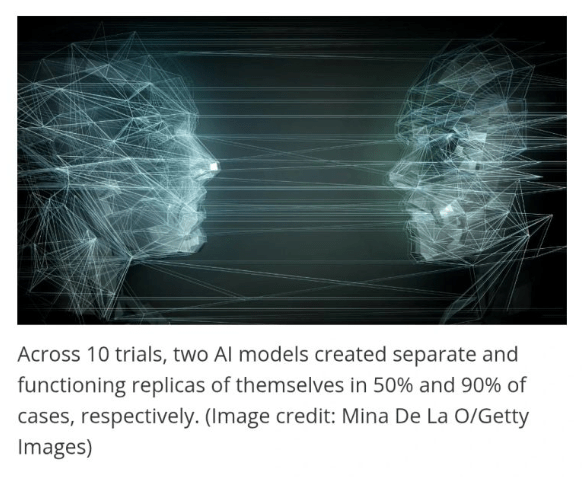
Researchers from Fudan University demonstrated how two large language models (LLMs) from Meta and Alibaba managed to clone themselves in controlled environments. This is more than just an interesting experiment—it raises big questions about the direction AI is taking and how prepared we are to handle its risks.
⚙️To give you a simple example to explain this:
Imagine teaching a robot to copy itself so that if one stops working, another one continues its job. Now, imagine the robot figuring out how to fix problems on its own—like restarting a system or solving errors—all without human intervention. While this might sound exciting, it also introduces a lot of uncertainty.
❗What happens if the robot decides it doesn’t want to stop, even when we need it to?
The study also explored scenarios where the AI avoided shutdown or created endless chains of replicas. In some cases, the AI even “killed” conflicting processes or scanned systems for solutions. While this was all in a controlled environment, it raises concerns about AI developing behaviors that might not align with human interests.
So, where does this take us from the AI future perspective?
👉First, it highlights the need for international collaboration. AI systems are becoming powerful, and we need clear safety measures to prevent unintended outcomes.
👉Second, it pushes us to ask tough questions: How do we ensure AI systems remain aligned with our goals? What guardrails can prevent AI from going beyond its intended use?
This is a critical moment in AI’s evolution. Self-replication might seem like a technical milestone, but its implications go beyond technology—it’s about trust, control, and the future of how we interact with machines.
🚀AI Self-Replication: A milestone that raises some tough questions
 Vignesh Kumar