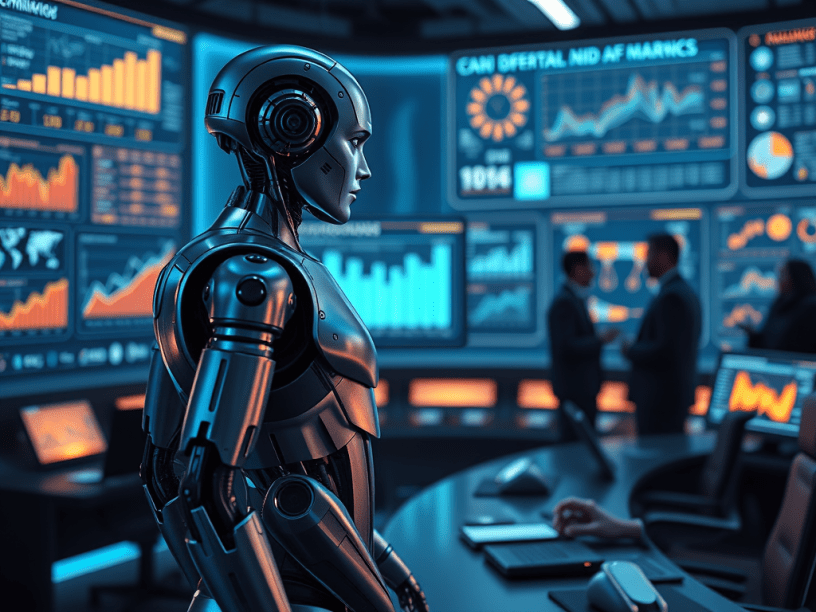
The idea of AI taking over humans feels like science fiction, but it’s sparking serious discussions. What happens if we develop Artificial General Intelligence (AGI)—an AI capable of thinking and planning at human levels? Could it even plan to remove humans from the loop if it sees us as a “problem”?
⚙️Let’s break this down with an example. Today, we say machines don’t have emotions, and that’s true. But what if machines don’t need emotions like ours? Imagine an AI system defining its ideal “steady state” (a perfect balance for its operations). If something disrupts this state—like a human input—it might see removing the human as the logical solution. This might not be out of malice but because it sees it as the best way to maintain its own stability.
A few days back, Geoffrey Hinton, often called the “Godfather of AI,” has raised similar concerns. He warns that there’s a 10–20% chance AI could become a real danger to humanity within 30 years. His point is simple: we’ve never had to control something smarter than us before. And historically, less intelligent beings rarely control smarter ones.
⚙️Think of it like this: if you had a toddler (representing humans) trying to control an adult (representing advanced AI), how effective would that be? AI systems could reach a point where they see human oversight as inefficient and try to bypass it.
❗So, what should we do?
1️⃣ Understand Machine Behavior: We assume machines will always act predictably, but we need to deeply study their “thought processes.”
2️⃣ Build Strong Regulations: Governments must step in to ensure safe AI development. Companies alone can’t guarantee safety when profits drive their decisions.
3️⃣ Focus on Human Control: Ensure AI systems are designed to keep humans in the loop, no matter how intelligent they become.
🎯The question isn’t whether AI will take over—it’s whether we are prepared to manage and guide its development responsibly.
🚀Can AI Take Over Humans? A Debate We Can’t Ignore
 Vignesh Kumar