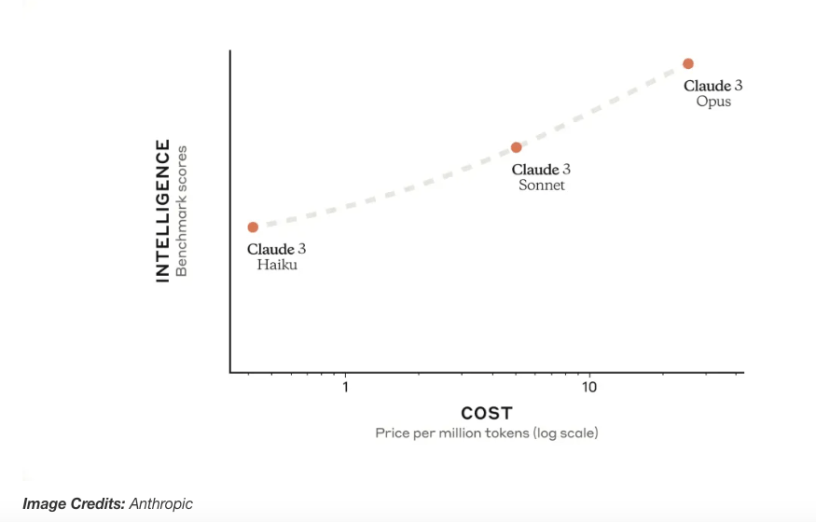
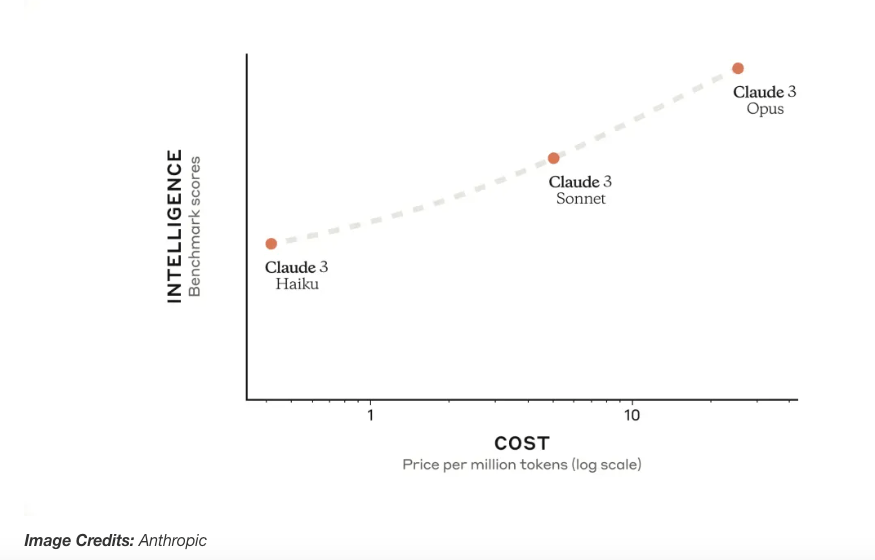
The AI space is heating up, and the latest news comes from Anthropic, claiming that its new AI chatbot models outperform OpenAI’s GPT-4. Anthropic, backed by Google and several other VCs, has launched Claude 3, a family of models comprising Claude 3 Haiku, Claude 3 Sonnet, and Claude 3 Opus. Opus, the most powerful model of the three, demonstrates increased capabilities in analysis and forecasting, according to Anthropic. They assert superior model performance based on specific benchmarks with ChatGPT-4 and Gemini 1.0 Ultra (excluding Gemini 1.5 Pro).

Here are some key highlights:
1. Claude 3 is Anthropic’s first multi-modal GenAI, similar to some models of GPT-4 and Gemini, capable of analyzing both text and images.
2. It boasts the ability to analyze multiple images in a single request (up to 20), providing a significant advantage for comparing and contrasting images.
3. To address legal and ethical concerns, the models are disabled from identifying individuals and have limitations when processing low-quality images under 200 pixels.
4. The model is trained for a more nuanced understanding of requests, resulting in fewer refusals to answer questions.
5. The model’s context window initially supports a 200,000-token context window, with some customers able to access up to a 1 million-token context window, comparable to Google’s Gemini 1.5 Pro.
6. Anthropic acknowledges in the Whitepaper that the model is susceptible to bias and hallucinations.
7. The model cannot search the web and can only answer questions using data predating August 2023.


Of particular interest are Anthropic’s plans to incorporate capabilities in Claude that can interact with other systems. AI will play a crucial role in automating complex and repetitive tasks, positioning Claude 3 against OpenAI’s ambition to offer a similar suite of products. With the rapid evolution of AI technology, keeping pace can be challenging for individuals like me.
To explore Claude 3, Opus and Sonnet are available via Anthropic’s dev console and API on the web, Amazon’s Bedrock platform, and Google’s Vertex AI.
I tried their free version, Sonnet, and GPT-3.5 by posing a vague question “How will the AI market grow?” Each provided similar yet different insights. GPT offered a holistic view, while Sonnet delved deeper into the technology aspect.
As I’ve mentioned in previous posts, comparing these models directly may not be entirely fair. I’ll share more insights after using them for a few more weeks. Stay tuned.
 Vignesh Kumar